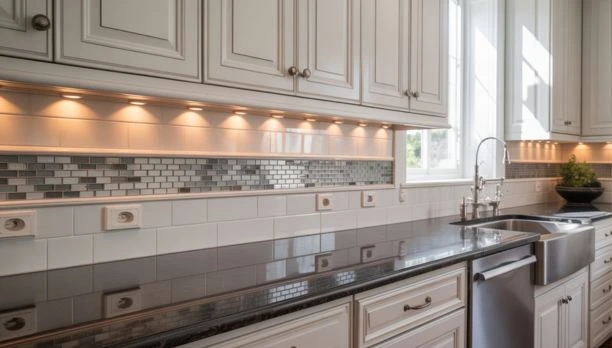
Transforming your kitchen workspace starts with smart illumination choices. Under cabinet lighting has evolved from basic utility fixtures to sophisticated design elements that enhance both functionality and ambiance.
Whether you’re planning a kitchen renovation or seeking to upgrade your existing space, understanding the nuances between puck lights and strip lights can dramatically impact your daily cooking experience and home value.
Why Under Cabinet Lighting Matters in 2026
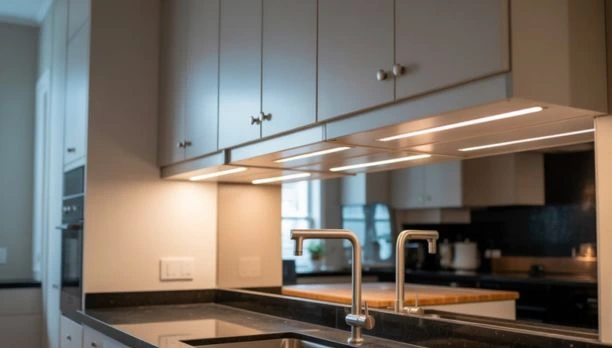
Modern kitchens demand more than overhead fixtures. Task lighting beneath cabinets eliminates shadows on countertops, improves food preparation safety, and showcases beautiful backsplashes. Industry data reveals that 89% of homeowners who install quality under cabinet lighting report improved kitchen functionality and increased home value.
At Poseidon Remodeling, we help homeowners choose the right solution based on their kitchen’s layout, style, and lighting needs.
The Evolution of Kitchen Illumination
Traditional fluorescent tubes and hot halogen bulbs have given way to energy-efficient LED technology. Today’s LED under cabinet lights consume up to 80% less energy than incandescent alternatives while delivering superior brightness, color accuracy, and lifespan. With options ranging from motion-activated wireless systems to smart home-integrated fixtures, 2026 marks a pivotal moment for kitchen lighting innovation.
Understanding Puck Lights: Focused Task Illumination
What Are Under Cabinet Puck Lights?
Puck lights are compact, disc-shaped fixtures that deliver concentrated beams of light to specific countertop areas. Named for their hockey puck-like appearance, these fixtures typically measure 2-4 inches in diameter and mount individually beneath cabinets.
Technical Specifications
Modern LED puck lights offer:
- Lumens: 100-400 lumens per fixture
- Color Temperature: 2700K-5000K options
- CRI (Color Rendering Index): 90+ for accurate color representation
- Installation: Surface mount, recessed, or adhesive
- Power Source: Hardwired, plug-in, or rechargeable battery
Ideal Applications for Puck Lighting
Spot Illumination: Perfect for highlighting specific work zones like coffee stations, cutting boards, or decorative display areas.
Accent Features: Showcase glass-front cabinets, open shelving, or architectural details with strategically placed puck lights.
Small Kitchens: Compact spaces benefit from targeted illumination without overwhelming the area.
Layered Lighting Design: Combine multiple puck lights to create depth and visual interest while maintaining focused task lighting.
Advantages of Puck Lights
Customizable Placement: Position individual fixtures exactly where light is needed most, creating tailored illumination patterns.
Aesthetic Versatility: Available in brushed nickel, white, bronze, and black finishes to complement any cabinet hardware and design style.
Easy Retrofitting: Wireless rechargeable models with magnetic mounting systems require no electrical work, making them ideal for renters or quick upgrades.
Dramatic Effects: Create pools of light and shadow that add architectural dimension to kitchen spaces.
Limitations to Consider
Coverage Gaps: Multiple fixtures are necessary for continuous countertop illumination, potentially creating dark spots between lights.
Installation Complexity: Hardwired systems require more planning and potentially professional installation for optimal spacing and wiring.
Higher Unit Costs: Achieving full coverage requires purchasing multiple fixtures, which can increase overall project expenses.
Strip Lights: Seamless Continuous Illumination
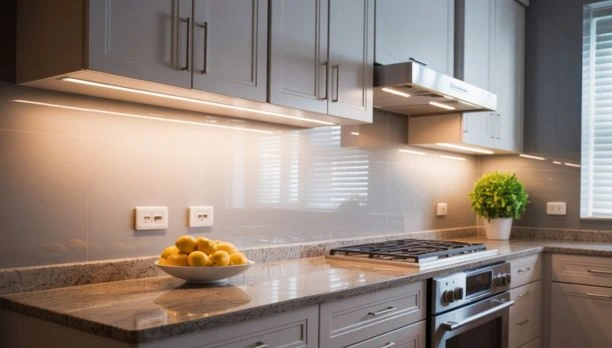
Understanding LED Strip Lighting
Strip lights feature continuous LED arrays embedded in flexible tape or rigid linear fixtures. These sleek systems mount along the entire cabinet length, providing uniform illumination without visible gaps.
Technical Characteristics
Modern strip lighting systems deliver:
- Lumens per Foot: 200-500 lumens
- Color Options: Single white, tunable white (CCT adjustable), or RGB color-changing
- Profile Heights: 3mm-15mm for minimal visibility
- Installation Methods: Adhesive backing, mounting clips, or integrated channels
- Control Features: Dimming, smart home integration, motion sensors
Best Use Cases for Strip Lights
Full Counter Coverage: Ideal for L-shaped or galley kitchens requiring consistent work surface illumination across extended cabinet runs.
Modern Minimalist Design: Hidden installation creates clean lines with invisible light sources that disappear during daytime.
Task-Heavy Workspaces: Food preparation areas, baking stations, and cooking zones benefit from shadow-free, evenly distributed brightness.
Open Concept Layouts: Continuous strips maintain consistent lighting throughout connected kitchen and dining spaces.
Benefits of Strip Lighting
Uniform Illumination: Eliminates hot spots and dark zones, providing consistent brightness across entire countertop lengths.
Streamlined Installation: Single-run systems simplify wiring and reduce installation time compared to multiple individual fixtures.
Energy Efficiency: Continuous LED strips often consume less power than equivalent puck light configurations while delivering superior coverage.
Invisible Design: Low-profile fixtures disappear beneath cabinets, maintaining focus on cabinetry and countertops rather than visible light fixtures.
Potential Drawbacks
Cutting Limitations: Rigid linear strips can only be cut at designated points, requiring precise measurements or custom lengths.
Replacement Considerations: Entire strip sections may need replacement if individual LEDs fail, though quality brands offer warranties of 50,000+ hours.
Initial Planning: Permanent installations require careful power source placement and consideration of future kitchen modifications.
Puck vs Strip Lights: Direct Comparison
| Feature | Puck Lights | Strip Lights |
|---|---|---|
| Coverage Pattern | Focused spots with spacing between fixtures | Continuous, uniform illumination |
| Installation Flexibility | Individual placement for custom layouts | Linear runs following cabinet dimensions |
| Typical Brightness | 100-400 lumens per fixture | 200-500 lumens per foot |
| Aesthetic Impact | Visible fixtures create dimensional lighting | Hidden sources provide clean, minimalist look |
| Best for Kitchens | Small spaces, accent lighting, display areas | Full countertop coverage, task-heavy zones |
| Average Cost | $15-$60 per fixture (multiple needed) | $20-$100 per linear strip kit |
| Maintenance | Individual fixture replacement | Section or full strip replacement |
| Dimming Capability | Most models dimmable | Nearly universal dimming support |
| Smart Home Integration | Available in premium models | Increasingly standard feature |
With kitchen trends 2026 focusing on clean lines and functional lighting, strip lights are becoming a favorite for modern homes. Their seamless design complements minimalist cabinetry and open shelving beautifully. Still, puck lights remain popular for homeowners wanting more character and depth.
Installation Methods: Professional vs DIY
Plug-In Systems
Best For: Renters, quick upgrades, budget-conscious projects
Process: Mount fixtures, route low-voltage cables, plug into outlet
Considerations: Visible cords require strategic placement near outlets or cord concealment solutions
Rechargeable Battery Options
Best For: Areas without nearby outlets, frequently rearranged spaces
Process: Magnetic or adhesive mounting with USB recharging
Considerations: Require periodic recharging (typically 30-90 days) and may offer lower brightness
Hardwired Installations
Best For: New construction, major renovations, permanent solutions
Process: Connect to household electrical system with wall switch control
Considerations: Requires electrical expertise or licensed professional, but provides clean installation and convenient operation
Selecting the Right Color Temperature
Warm White (2700K-3000K)
Creates cozy, inviting ambiance similar to traditional incandescent bulbs. Ideal for evening entertaining and complements wood cabinetry and warm-toned countertops like granite or butcher block.
Neutral White (3000K-4000K)
Balanced illumination that transitions smoothly from morning task lighting to evening atmosphere. Most versatile choice for kitchens with mixed design elements and varying daily usage patterns.
Cool White (4000K-5000K)
Crisp, energizing light that enhances concentration and color accuracy. Preferred for modern designs with white or grey cabinetry, quartz countertops, and high-volume cooking activities.
Consider a home with old kitchen cabinets, dark wood, limited visibility, and shadows over every work surface. By pairing cabinet updates with under cabinet lighting from Decor Cabinets, the space is instantly transformed.This approach highlights clean lines, elevates countertops, and supports the minimalist style trending in today’s designs.
Smart Under Cabinet Lighting Features
Motion Sensor Technology
Hands-free operation automatically illuminates work areas upon movement detection, switching off after inactivity. Enhances convenience while preparing food with messy hands and contributes to energy savings through automatic shut-off.
Voice Control Integration
Compatible systems connect with Amazon Alexa, Google Assistant, or Apple HomeKit for hands-free commands like “turn on kitchen lights” or “dim under cabinet lights to 40%.”
App-Based Customization
Smartphone control enables scheduling, scene creation, brightness adjustment, and color changing from anywhere in the home or remotely for security simulation while traveling.
Dimming Capabilities
Smooth brightness adjustment from 0-100% allows transition from bright task lighting during meal preparation to soft ambient glow during dinner parties and late-night snack raids.
Energy Efficiency and Cost Analysis
LED Technology Advantages
Modern LED under cabinet lighting delivers:
- Lifespan: 50,000+ hours (15-20 years at average usage)
- Energy Consumption: 4-10 watts per linear foot
- Heat Generation: Minimal compared to halogen or fluorescent
- Environmental Impact: No mercury or hazardous materials
Return on Investment
Quality LED systems save $50-$100 annually compared to traditional alternatives while eliminating bulb replacement costs. Initial investment of $100-$400 for complete kitchen lighting typically pays for itself within 3-5 years through energy savings and avoided maintenance expenses.
Utility Rebates and Incentives
Many utility companies offer rebates for LED lighting upgrades. Check with local providers for programs that may reduce initial costs by 20-30% for qualifying energy-efficient installations.
Professional Installation vs DIY
When to Hire an Electrician
Consider professional installation for:
- Hardwired systems requiring household electrical connections
- Installations involving cabinet modifications or drilling
- Complex configurations with multiple zones and switches
- Situations where electrical codes require licensed work
Cost: Professional installation typically adds $150-$500 depending on system complexity and local rates.
Successful DIY Projects
Homeowners with basic skills can handle:
- Plug-in strip lights with adhesive mounting
- Rechargeable puck lights with magnetic installation
- Low-voltage systems using existing outlets
- Pre-wired kits with detailed instructions
Savings: DIY installation eliminates labor costs while allowing custom placement and personal satisfaction.
Maintenance and Troubleshooting
Cleaning Best Practices
Frequency: Wipe fixtures quarterly with dry microfiber cloth
Products: Avoid harsh chemicals; use mild soap solution if necessary
Caution: Ensure power is disconnected before cleaning hardwired systems
Common Issues and Solutions
Flickering Lights: Check dimmer compatibility, replace incompatible dimmers with LED-rated versions
Uneven Brightness: Verify consistent power supply, inspect connections for corrosion or looseness
Premature Failure: Ensure adequate ventilation, avoid installing above heat-generating appliances like toasters
Remote Control Problems: Replace batteries, verify line-of-sight for infrared remotes, check WiFi connectivity for smart systems.
Top Under Cabinet Lighting Brands for 2026
Premium Segment
Philips Hue: Industry-leading smart integration with full RGB color control and seamless ecosystem compatibility
WAC Lighting: Professional-grade hardwired systems with exceptional build quality and designer finishes
Kichler: High CRI fixtures delivering accurate color rendering with elegant aesthetic options
Mid-Range Options
Litever: Comprehensive kits balancing performance and value with complete installation hardware
LEPOTEC: Motion sensor technology at accessible prices with rechargeable convenience
Wobane: Reliable strip systems offering warm illumination and remote control at budget-friendly prices
Budget-Friendly Choices
Brilliant Evolution: Wireless battery-operated puck lights for rental-friendly installations
MCGOR: Motion-activated systems delivering essential functionality without premium pricing
ASOKO: Adjustable color temperature options providing versatility across price points.
Future Trends in Under Cabinet Lighting
Adaptive Lighting Systems
Emerging technology automatically adjusts brightness and color temperature based on time of day, ambient light levels, and detected activities, mimicking natural daylight patterns to support circadian rhythms.
Enhanced Color Rendering
Next-generation LEDs achieving CRI 95+ deliver museum-quality color accuracy, ensuring food appears exactly as intended while enhancing the visual appeal of ingredients and finished dishes.
Ultra-Thin Profiles
Continued miniaturization enables fixtures as thin as 2mm that virtually disappear beneath cabinets while maintaining impressive brightness and durability.
Sustainable Materials
Manufacturers increasingly utilize recycled aluminum, biodegradable adhesives, and modular designs supporting repair and component replacement rather than complete fixture disposal.
Ready for a Well-Lit Custom Kitchen?
Under cabinet lighting is an essential element that can transform your kitchen remodel oceanside. It enhances both the functionality and aesthetics of the space, providing clear, bright illumination for meal prep while adding a beautiful glow to your countertops. Whether you’re looking for subtle ambient light or focused task lighting, under cabinet light offers versatility and style.
Explore Your Options with Experts
At Poseidon Remodeling, we specialize in custom lighting solutions that integrate perfectly with your kitchen design. Whether you’re planning a kitchen remodel or a whole home remodeling oceanside project, our team can help you choose the best lighting options for your space.
Let’s Bring Your Vision to Life
If you’re ready for a well-lit custom kitchen, get in touch with us today. We’ll guide you through every step of the process, from selecting the perfect under cabinet lighting to making your kitchen remodel a stunning success.
Final Thought
The puck versus strip lighting debate ultimately depends on your specific kitchen layout, design preferences, and functional priorities. Both technologies have evolved dramatically, offering exceptional performance, energy efficiency, and installation flexibility that transforms ordinary kitchens into well-lit, functional spaces.
By carefully considering your counter configuration, aesthetic goals, and daily usage patterns, you can select the under cabinet lighting system that perfectly balances practical illumination with visual appeal. Whether you choose the focused intensity of puck lights, the seamless coverage of strip lights, or a strategic combination of both, quality LED technology ensures years of reliable service while elevating your kitchen experience.Ready to illuminate your kitchen transformation? Contact us now.
FAQs
What’s the average lifespan of LED under cabinet lights?
Quality LED systems typically last 50,000+ hours, equating to 15-20 years with average daily usage of 8-10 hours. Premium brands often include warranties of 3-5 years, reflecting confidence in long-term performance.
Can I install under cabinet lighting myself?
Plug-in and rechargeable systems are DIY-friendly, requiring only mounting and power source access. Hardwired installations involving household electrical connections may require licensed electrician services depending on local codes and personal skill levels.
How much does professional under cabinet lighting installation cost?
Material costs range $100-$400 for complete kitchen systems. Professional installation adds $150-$500 depending on complexity, with hardwired configurations at the higher end and simple plug-in systems requiring minimal labor.
Will under cabinet lights increase my electricity bill?
LED systems consume 4-10 watts per linear foot, adding approximately $5-$15 annually to electricity costs with typical usage. This represents 80%+ savings compared to traditional incandescent or halogen alternatives.
What color temperature should I choose for my kitchen?
Warm white (2700K-3000K) suits traditional designs and evening ambiance, neutral white (3000K-4000K) offers versatility for most kitchens, and cool white (4000K-5000K) provides energizing task lighting for modern spaces. Consider tunable systems for maximum flexibility.